


George M. Jewett
- Don Schueler
- Mar 31
- 14 min read

George M. Jewett's 2008 Web Site
Maybe it was the generation I was born in, but I had come to realize that I knew surprisingly little of my parents upbringing and life before I entered it! I do not believe even today parents sit down with their children and take the time to tell them interesting stories of their growing up. My daughter, Kristianne, has many times asked me to email her stories of my younger life and I have given her bits and pieces but she was always looking for more. My son, Lamon, is getting his Master's Degree in Writing, Directing and Film Making and since he was born when I was 50 knows little of my younger years! I became really involved in computers in 1979 after I left the precious metals recovery business, and started building them from the motherboard up, but I will go into that story later, but surfice to say this is why I am writing the following on my web site. So I begin.My Early Years 1929 to 1945 Covered in Talk to Old East Hampton


Nineteen Forty-five to Nineteen Forty-seven
I had been going to Carteret Day School in West Orange, NJ for the past 2 years and my Mother decided it would be a good idea for me to join my Brother Jed, Edward H. Jewett III, at Manius Military School in New York state near Syracuse, NY! I was happy at Carteret where I played on the Varsity Baseball Team as most of the seniors spent their time drinking and chasing girls. My closest friends were Dave Hall and Bill Smith and we played and practiced baseball seven days a week! I started at Manlius in the Fall of 1945 which was my Brother's senior year.
"Edward Hull Jewett Jr. An article published in the Suffolk County News on August 21, 1942 detailed an interesting war time event Edward participated in. On August 6, 1942 Lieutenant Commander Edward H. Jewett Jr. presented his ship, the PC-468, a submarine chaser, to Queen Wilhelmina of the Netherlands as part of the Lend-Lease Act. The transfer of the ship took place at the Washington Navel Yard with speeches given by President Roosevelt and Queen Wilhelmina."

I joined a flying club at Manlius in the fall of 1944 which used an airport at Canastota , NY, about 14 miles from the school. We would have to hitch-hike to the airport for our flying lessons from Dick Richards, our flight instructor. He had 3 Luscombe Silvaires which he used for lessons and for solo flight for his students. These great airoplanes are still being built today in Riverside, CA This aircraft was all metal and although a hi-wing monoplane was stressed for aerobatics so Dick's instructions included loops, snap rolls, stalls and spins which are rarely taught today. Instuctions were $6 an hour and Solo $4 per hour! I had to wait for my 16 birthday in January 1945 to solo but I went on to get my private pilots license later that year which required 40 hours of flying time including a 3 destination cross country trip.

I had done a lot of hunting and shooting as a kid so I joined the Manlius Rifle Team and was on it for my full 3 years at Manlius until I graduated in 1947:

The cadet standing behind me was my roommate Stanley M. Umstead who went on to West Point and retired as a Lt. General in the Air Force. I sorry to report he died in 2003 and is buried at Arlington National Cemetery.

We were formed at Manlius into 4 companies: A, B, C, and HQ. I was in A Company, a Staff Sargent which is equivalent to a Squad leader:


I also played on the varsity tennis team and of course was a member of the Flying Club and the Rifle Team for three years.

Nineteen Forty-seven to Nineteen-fifty
Graduating from Manlius Military School in the Fall of 1947, I proceeded to enter the first year of a two year course at a new engineering college, Northrop Aeronautical Institute, located at Northrop's manufacturing plant in Englewood, CA.
When I arrived in California I found a place to stay with 4 other students in a rented cottage in Torrance, not far from the Northrop factory. One of my classmates was no spring chicken, and at 27 had retired from the Navy as a commander with over 8,000 hours flying time. Ed Collard had racked up this many hours ferrying planes to Europe and then instructing at Norma, Oklahoma Navy base. He had received many offers to become a test pilot from various aircraft manufacturing companies if he could get his engineering degree! We became good friends and he and his wife would have me over for dinner at their apartment regularly. He new my love of flying and said that for the fun of it we should look for what was available for sale.

All of the ones we looked at needed to be recovered as you could leave a dent in the canvas with your thumb. We stumbled on a Fleet that had been bought by Cal Aero to be used in the mechanics training course and the Kinner engine had been completely rebuild and all the fabric replaced and painted green with silver wings. Ed told me that this model had been used by the Canadian Air Force in the Second World War as a primary trainer and was actually faster and more aerobatic than the Stearman! Cal Aero was asking $750.00 so I offered them $500 and they accepted, so at 18 I was the proud owner of NC 53Y. Ed and I flew almost every day and all weekends. He put me through the Navy's Aerobatic Training Course after we had purchased reliable parachutes! I had a ball and will go into more detail later.

I, for years, thought my plane was built in 1926, but if the article below is correct, it was probably built in 1930, a year after I was born!
The History Of The 1930 FleetBy Frederic Howard(Published in the June 1967 Issue of the American Aviation Society Journal)
The Fleet Biplane was named for Maj. Reuben Fleet who was the guiding hand at Consolidated Aircraft at the time. Fleet Aircraft Inc. was set up as a subsidiary of Consolidated and was headed by Larry Bell, later famous for the line of aircraft bearing his name, to perform the manufacturing functions.
Consolidated Aircraft of Buffalo N. Y. developed the Fleet in 1928 to supplement the company's successful PT and "Husky" series of training aircraft. The Fleet was not a derivation of the PT series but a brand new design throughout and, whereas the PT and "Husky" airplanes had been primarily slanted to meet the requirements of the military, the Fleet series of aircraft targeted the civilian market.
This desire to attract the civilian buyer accounted for the machine being designed around the Warner "Scarab" engine of 110 hp. The commercial operators of the day, having been conditioned by the inexpensive OX-5 engine, could hardly be expected to eagerly welcome the cost and the expense of supporting over 200 hp (as used in the PT-3) in an airplane built only to teach flying. The engine initially chosen for the Fleet series, the Warner "Scarab", was probably the best of the new engines then appearing on the market in the 90-120 hp range and the Fleet Model 1 found widespread acceptance very quickly as a civilian training machine.
There was little carry-over from the "Husky" to the Fleet. Dimensionally, they were quite different, and except for a few details, such as the type of windscreen and the fuel arrangement, it would be difficult to find features tying the two designs together. In spite of that, the first Fleets were sometimes called "Husky Junior". Formally they were known as the Consolidated Model 14, a design that received ATC #84 on 10 November 1928 and was approved for the Warner Scarab engine. In 1929, a slightly reworked version of the Model 14 was produced under ATC #122 (issued 15 June 1929) and named the Fleet Model 1. Fleet Model 2 also dates from June 15, 1929 and was certified under ATC #131. Both the Model 1 and Model 2 used the Kinner K-5 engine. The third popular Fleet design, the Model 7 powered by the Kinner B-5 of 125 hp, was placed in production in 1930 and received ATC #374 in October 4 of that year.
Throughout the 1930s Warner "Scarab" and Kinner K-5 and B-5 Fleets were common everywhere in the United States, but they were particularly popular on both coasts. In the east, for example, the Roosevelt Flying School of New York operated Fleets for many years. In Southern California, Fleets were available at almost every airport where, quite unlike today, a considerable number of impending bankrupts, called "fixed base operators," scratched a precarious living renting them out to "Sunday Flyers" and providing flying instruction (of a sort) in half-hour increments. The rental was almost always the same whether the owner-operator went along to provide "flying instruction" or not. His services came free. The charges for Fleets ranged from $6 to $8 per hour with the poorer Los Angeles area fields like Dycer or Culver City offering the lower prices.
The specifications for the K-5 Fleet listed a cruising speed of 95 and the top speed of 110 but everybody knew better than to believe it. No one expected to go anywhere in a hurry in a Fleet and so the fact that it might, if everything was set just right, cruise at 85 was interesting but not important. It was just nice to be up there in this fun aircraft so nobody held it against the airplane. That fact seems strange today in this fast paced world, but in the 1930s just cruising leisurely over the countryside was something special.
The 1929 Directory issue of Western Flying listed the price of the Fleet Model 2 as $5,500 at the factory, Buffalo, N. Y. By 1931, the depression had forced the price down to $3,985.
(The following information was taken from a 1930 Sales Brochure). The Fleet Airplane is a two-seat, open cockpit, staggered tractor biplane having the following general dimensions:Span 28 FeetWing Chord 48 InchesWing Area 194.4 Sq. Ft.Horiz. Stabilizer Area 13.7 Sq. Ft.Elevator Area 10.8 Sq. Ft.Fin Area 2.9 Sq. Ft.Rudder Area 8.2 Sq. Ft.Aileron Area 21.7 Sq. Ft.Landing Gear Tread 76.75 InchesOverall Length 21 Feet 8 InchesHeight (landing Position) 7 Feet 9 InchesWing Incidence 2°Upper Wing Dihedral 0°Lower Wing Dihedral 4°Gap at center section 54 InchesStagger 23 InchesTire Size 8.50 x 10 (7.50 x 10 and 6.50 x 10 also available)Engine Kinner 5 cyl K-5 100 hp.B-5 125 hp.R-5 160 hp.
Wing CelluleWing panels are made of laminated spruce spars, stamped sheet Duralumin leading edges, trailing edges, ribs, walkboards, and center section cutout. Covering is cotton airplane fabric. Interplane struts comprise of streamlined chrome alloy tubing. Ailerons are triangulated spruce structure, fabric covered.
Tail SurfacesAll tail control surfaces have alloy steel tabular spars and stamped sheet steel ribs. Stabilizer is adjustable in flight from either cockpit and the fin is adjustable on the ground.
FuselageThe fuselage structure is made of chrome molybdinum steel tubing with welded joints. Fuselage is covered with fabric. Fairing strips under the covering on the sides prevent flapping of the fabric. Engine cowling consists of nose cowl, top cowl, bottom cowl, and two side doors. Engine compartment side doors are easily opened and top cowls are easily removed. All other cowlings are held on by Oval countersunk machine screws and special washers.
CockpitsThe adjustable seats are of all metal construction and designed to take parachutes. They are securely fastened to the fuselage structure and have a quick-release buckle.
Windshields are of PyralinInstrument boards are slanted at a restful angle to the eye and are provided with curled-hair upholstered crash pads to protect the pilot's face. Normally the front cockpit is the Master cockpit whose instrument panel contains the following controls and instruments: Primer and Primer Shut-off cock, Carburetor Heat Control, Mixture Control, Tachometer, Oil Pressure Gauge, Oil Temperature Gauge, and the Altimeter. Standard instruments may be installed in the rear cockpit at an additional cost. Air Speed and Bank Indicators may also be mounted and a compass may be mounted under the front spar of the upper wing in view from both cockpits. The ignition switch is normally located in the front cockpit with an extension rod to the rear cockpit. Throttle controls are installed in both cockpits on the left side.
Standard colors are yellow or light yellow for the wings and stabilizer, and blue, green, or red for the fuselage, fin, rudder, landing gear and struts.

While at Northrop I watched the P-61 Black Widow Night Fighter as it was being build and many experimental planes including the YB 49 flying wing bomber. I watched it's first flight in October 1947 and it was a spectacular plane.
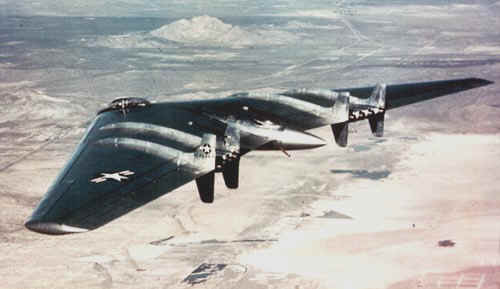
I occasionally would dog fight with Navy SNJ Trainers probably from North Island Naval Base near San Diego, and because I could turn in a tighter circle than they could I would be able to get on top of them and it was always in good fun and they would give me a thumbs up and fly off and of course I could not keep up with them. On one weekend I landed at Lake Arrowhead on Big Bear and because they had a commercial DC 3 coming in behind me , the tower forced me to turn off on a taxi strip where the snow had been plowed up higher than my lower wing and ice had formed on the top. This caused rips in the canvas on both lower wings and I couldn't have it repaired as it was too cold. The tower told me to fly down to the Marine Air Station at Twenty-nine Palms and their repair facility would help me. They had a medal mat runway and my tail wheel was steerable with 2 cables running back and coordinating with the rudder pedals. The hooks on the end of the cables were open and caught on the metal mat and were immediately straightened and came undone and so I had to stear by the rudder alone! Their Navy mechanics were good and they applied patches with dope and then spay painted them silver and re hooked the cables on to the tail wheel and the total job took 30 minutes and they charged me $12! You had to look closely to see where the rips had been so repairing a canvas covered plane was easy and inexpensive.

One day while I was flying over the ocean near Culver City I noted that Hughes Flying Boat, nick- named the Spruce Goose, was taxing in the harbor and started to pick up speed as I flew over it. I noted that it broke water and was in the air for a few moments and then landed again. I wish I had a camera as this was the only time the plane flew!

Obviously someone had a camera and got this shot but no one was really prepared because it was only suppose to be a taxi run and shocked everyone when it took off! Howard Hughes was at the controls and because he actually flew the plane he met his government contract! When ever I was in Long Beach, CA I would visit the plane and marvel at it's size. It has since been moved to Evergreen Oregon where a space museum has been built around it which you can check out at Evergreen Air Venture Museum.
After school, in the Summer of 1948, I stowed the front wind screen in the front cockpit which I then covered with an aluminum cowling fastened with zeus fasteners, and this gave me a cruising speed of 110 Knots instead of 90 Knots. I then proceeded to fly back to Morristown, NJ where I startled my Step- Father and Mother by diving on them while they were playing golf at the Essex Country Country Club!
My Tennis History
An Interesting Time to Play Tennis
I started playing tennis at the Bath & Tennis Club in Spring Lake , NJ in 1936. Today a 107 year old tennis club!


The tennis pro was Mercer Beasley who also was the coach of the Princeton Tennis Team. All the courts were green clay and I would hit against the backboard for hours at a time when I wasn't taking lessons from Mr. Beasley! Franciszek A. Paikowski who was born in 1916 in WI and when he was a boy was spotted hitting tennis balls by Mercer Beasley and Mercer decided to make him his protege as he saw a natural talent in the boy! Mercer and his wife, Audrey, then adopted Franciszek A. Paikowski.
Click HERE to see more about Mercer.


Comments